Vigyan Bhavan & Kempinski Ambience
10 - 14 February 2014
Delhi, India

Blog Archives For Blogs Tagged nutrition

Avocado fruit tree
According to the United Nations Populations Fund, the world is experiencing the largest wave of urban growth in recorded history. And as the population of cities swells to five billion by 2030 as projected by the UN agency, food and nutritional security is emerging as one of the biggest challenges in urban areas.
At the forthcoming World Congress on Agroforestry 2014, Eefke Mollee and co-researchers from Bangor University will discuss agroforestry in Kampala city, and how a focus on farming fruit trees in peri-urban and urban areas can help tackle major issues such as urban poverty and malnutrition.
In their study, the scientists say poor urban households often maintain close links with their previous rural (agricultural- and forestry-based) backgrounds. This means that forests and agroforestry systems in and around cities can provide urban areas with traditional forest products, providing employment and food security.
According to UN drylands ambassador Dennis Garitty, the demand for high value tree products in cities can also promote the expansion of agroforestry in urban areas.
“The growth of cities around the world has increased the market demand for fruit, timber and a host of other tree products, a force that is slowly transforming areas around cities into agroforests,” said Garrity in a recorded interview.
Mollee and co-researchers say urban forests and forestry systems are largely ignored in forestry debates, and little research has been done on their contribution to household nutrition.
“It is a missed opportunity, since the cultivation of nutrient-rich fruit trees could form important opportunities for growing urban populations,” they say in their Congress abstract titled ‘Linking urban agroforestry and nutrition: a case study from Kampala, Uganda.’
“With the limited space available in peri-urban and urban areas, fruit trees epitomize the concept of ‘vertical production,” they add.
Further reading:
See http://www.worldagroforestry.org/africa-food for links and more stories
By Isaiah Esipisu
—
Edited by D. Ouya

Agroforestry can improve food security
Kenyan athletes returning home from their characteristic winning performances are usually welcomed with a gourdfull of mursik—a specially fermented milk preserved with the ash of the indigenous tree species Senna didymobotrya (syn. Cassia didymobotrya), known locally as Itet.
However, with the pressures of climate change and human activities, important indigenous tree species such as Itet face the risk of decimation. These trees and related herbal shrubs have great cultural importance, yet are neither domesticated nor commercialised.
At the World Congress on Agroforestry, Anja M. Oussoren of AgriPRO, Ivory Consult Ltd will explain how her company is working with partners to conserve and commercialise the healthy foods derived from indigenous trees in Kenya.
The company works together with ethnobotanists, horticultural scientists, food, beverage and nutraceutical companies, food scientists, lawyers and policy makers, in the identification and prioritization of indigenous trees for conservation, propagation, regeneration and commercialization. The company is using an innovative technique known as Indigenous Trees Incubators (ITIs) in this effort.
So far, says Oussoren, extensive conversations and in some cases draft memorandums of understanding are in place with Kenyan and international gene banks, national agricultural and forestry research centres, ministries of agriculture and environment, county decision makers, community representatives, research universities, food and beverage companies, and research foundations.
By Isaiah Esipisu
—
Edited by D. Ouya
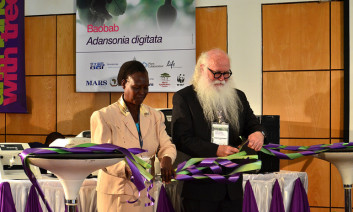
Hearty applause mingled with the sound of drumbeat at the World Agroforestry Centre (ICRAF) as the African Plant Breeding Academy came into being shortly after midday on 3 December 2013. The Academy, an initiative of the African Orphan Crops Consortium (AOCC),[1] is hosted by ICRAF and will be used to train around 250 African scientists in the latest biotechnological techniques to optimize the yield and nutritional content of 100 important but little-researched edible crops and trees native to Africa. Grown widely on farms, the improved varieties will help address the serious challenge of poor health caused by chronic malnutrition and recurrent episodes of hunger among Africa’s populations, especially the rural poor.
Professor Onesmo ole MoiYoi, the event’s keynote speaker, was emphatic: “We have to get serious about getting people out of episodes of starvation,” he said. Ole MoiYoi, chair of the Kenya Agricultural Research Institute Board, discussed the many dangers of poor nutrition in mothers, babies, and young children. These include an acquired predisposition to life-threatening conditions like coronary disease, hypertension, certain cancers, and even schizophrenia, later in life. “Imprinting during fetal development commits an individual to develop traits that can be passed on to grandchildren,” he stated, citing observations from Europe and China.
Click here for full article