
Vigyan Bhavan & Kempinski Ambience
10 - 14 February 2014
Delhi, India

Blog Archives For Blogs Tagged livestock

Agroforestry can enhance pasture production
In times of drought, pastoralists are among the groups hardest hit, when lack of fodder threatens their main source of livelihoods — their livestock. But researchers say agroforestry can be used to generate enough pasture to see livestock during dry spells.
In an abstract to the upcoming World Congress on Agroforestry titled ‘Improving productivity of common grazing resources in hot arid region of India through participatory pasture development,’ Arun Misra of the Central Arid Zone Research Institute (CAZRI) in India and co-researchers say planting particular drought-tolerant tree species can provide pasture to sustain livestock through a “drought window.”
In a trial on a total of 56 hectares of common lands in four different areas in India, the researchers intercropped two common grass species (Cenchrus setigerus and Lasiurus sindicus) with four drought-tolerant tree species (Acacia senegal, Acacia tortilis, Azadirachta indica and Prosopis cineraria).
After three years of establishment, productivity of the common lands rose to between 1.5 and 2.7 tons of dry fodder per hectare. This was a huge improvement on natural pasture, which produced just 0.5 tons per hectare.
The harvested dry biomass was chopped and stored as ‘fodder bank,’ and made available to the most vulnerable sections of the society during the subsequent drought period.
In another paper at the Congress, researchers from Tamil Nadu Agricultural University will discuss silvipasture models for meeting fodder requirements. The scientists say tree-grass intercrops were able to improve fodder yield. Their study found that cenchrus, guinea grass and desmanthus were the most suitable fodder crops for a Pongamia pinnata-based silvipasture system.
They conclude that adoption of suitable silvipasture models in the drylands of TamilNadu will not only help meet fodder requirements, but could enhance the overall productivity of the region’s drylands.
By Isaiah Esipisu
—
Edited by D. Ouya
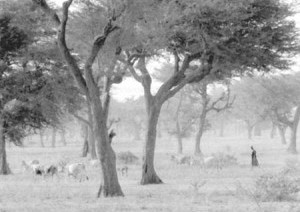
In the agroforestry parklands of the Sahel, generations of farmers have integrated crops, livestock and trees. With increasing pressure on natural resources to provide fuel, food and fodder for a growing population, farmers and scientists are looking at how these systems can best be intensified to increase productivity.
“Trees, crops and livestock all benefit from each other in the parkland farming systems of countries such as Burkina Faso and Mali,” explains Jules Bayala, Senior Scientist in Ecophysiology with the World Agroforestry Centre. “But to ensure all components are as productive as they can be relies on better integration and increased knowledge about the dependency, competition and complementarity of each element.”
In the agroforestry parkland farming system, livestock – cattle, sheep, goats, pigs, camels, donkeys and foul – are kept as a source of food, transport, power and cash. During the dry season, livestock freely browse in the parklands, providing manure that improves soil fertility and helps nourish trees and crops. Livestock also disburse the seeds of trees and sometimes break seed dormancy.
Click here for the full article